


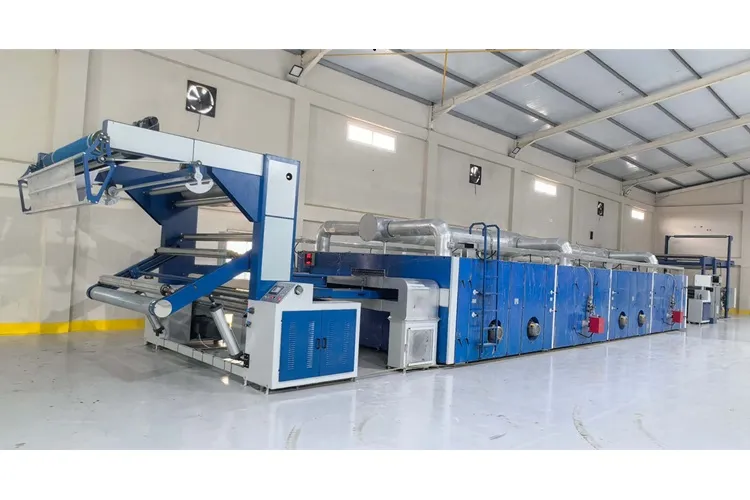

A sectional warper is a key piece of equipment in the textile industry used to prepare warp yarns for the weaving process. Here's a detailed explanation of how it works:
Yarn Supply and Unwinding
Yarn Package Setup: Yarns are initially wound on individual packages such as cones or cheeses. These packages are placed on a creel, which is a large frame designed to hold multiple yarn packages. The creel can be of different types, like vertical or horizontal, and it allows for easy unwinding of the yarns.
Unwinding Process: As the machine starts operating, the yarns are unwound from the packages on the creel. To ensure smooth unwinding, the creel may be equipped with tensioners. These tensioners apply a certain amount of resistance to the yarn, preventing it from unwinding too quickly or in a disorderly manner.
Yarn Guiding and Tensioning
Guiding Elements: After unwinding, the yarns pass through a series of guiding elements. These include yarn guides, which are small devices that direct the yarns along a specific path. They ensure that the yarns do not tangle with each other and are properly aligned for the subsequent processes.
Tension Control: Tension control is crucial for achieving uniform warp yarns. The sectional warper is equipped with a tension - control system. This system can be mechanical, pneumatic, or electronic. For example, in an electronic tension - control system, sensors measure the tension of each yarn, and the system automatically adjusts the tension by applying appropriate braking or pulling forces to maintain a consistent tension level across all the yarns.
Sectional Winding
Sectional Beam Preparation: The warper has a sectional beam, which is a narrow, cylindrical drum. The total number of warp yarns required for a particular fabric is divided into several sections. Each section will be wound onto the sectional beam one by one.
Winding Process: The yarns are wound onto the sectional beam in a parallel and evenly spaced manner. The machine controls the speed and direction of the winding. As the beam rotates, the yarns are laid side by side to form a layer. The width of each section on the beam is determined by the machine's settings and the requirements of the fabric being produced.
Layer Building: After one layer of yarn is wound, the machine may perform a traverse motion. This means that the yarns are gradually shifted laterally on the beam to build up multiple layers. The traverse motion helps to ensure that the yarns are evenly distributed across the width of the section and that the winding is compact and stable.
Pattern and Length Control
Pattern Creation: In some cases, the sectional warper can be programmed to create specific patterns in the warp yarns. This is achieved by controlling the order in which different colored or textured yarns are wound onto the beam. For example, if a fabric requires a striped pattern in the warp direction, the machine can alternate between different yarns at the appropriate intervals.
Length Measurement: The machine also keeps track of the length of the yarn being wound. It uses a length - measuring device, such as a encoder or a measuring roller. Once the desired length of yarn for a particular section is reached, the machine stops the winding process for that section and may start winding the next section.
Combining Sections (Beaming)
Sectional Beam Assembly: After all the required sections are wound onto the sectional beams, the next step is to combine these sections into a single warp beam. This is done using a beaming process. The sectional beams are placed side by side on a special frame.
Transfer to Warp Beam: The yarns from all the sectional beams are then transferred simultaneously onto a large warp beam. This warp beam will be used directly on the loom for the weaving process. During the transfer, the yarns are carefully aligned and tensioned to ensure that they are ready for weaving.
https://www.newpowertex.com/