


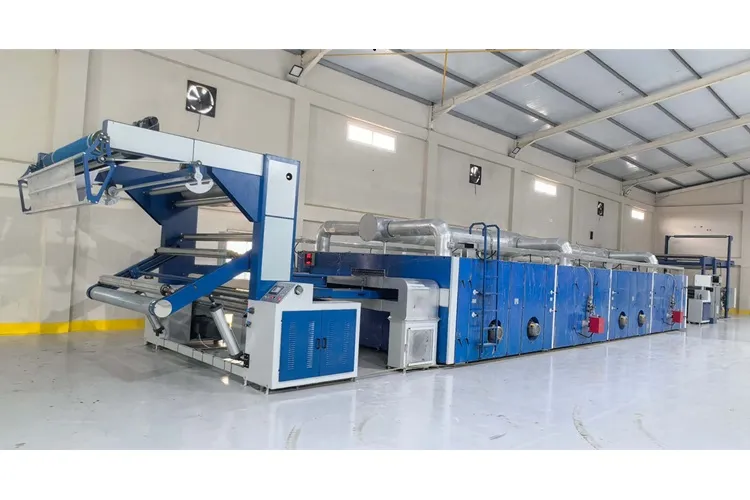

In the field of textile manufacturing, knitting machines are divided into two main categories based on yarn feeding methods: weft knitting machines and warp knitting machines. Among them, the warp knitting machine is a specialized equipment designed for producing warp-knitted fabrics, which plays a crucial role in the production of high-performance, multi-functional textiles. Below is a detailed breakdown of its core concepts, working mechanisms, and practical value.
Basic Definition: What Makes a Warp Knitting Machine Unique?
A warp knitting machine is a textile machine that uses multiple parallel yarns (called "warp yarns") to form loops simultaneously along the length direction of the fabric (warp direction) and interlocks these loops to create a continuous fabric. Unlike weft knitting machines (which use a single or a few yarns fed horizontally to form loops), warp knitting machines rely on a "grouped yarn feeding" method-hundreds or even thousands of warp yarns are arranged in a straight line and fed into the machine at the same time, enabling high-speed, large-scale production of fabrics with stable structures.
The fabrics produced by warp knitting machines are called "warp-knitted fabrics." They are known for their high-dimensional stability (less prone to stretching or shrinking), strong tear resistance, and clear texture-properties that make them irreplaceable in many industrial and daily-use scenarios.
Core Working Principle: How Does It Weave Fabric?
The working process of a warp knitting machine can be summarized in three key steps, each relying on precise coordination between mechanical components:
First, hundreds to thousands of warp yarns are wound onto a warp beam (a large cylindrical roller) after being sorted and tension-adjusted. The warp beam feeds the yarns evenly into the machine at a constant speed, ensuring each yarn maintains consistent tension-this is critical to preventing fabric defects like uneven loops or yarn breakage.
The core component responsible for loop formation is the needle bed (equipped with hundreds of knitting needles) and the guide bars (thin metal bars with small holes for threading yarns). As the machine operates:
* The guide bars move back and forth horizontally (or in a curved trajectory) to guide the warp yarns around the knitting needles.
* The knitting needles rise and fall to hook the yarns, pull them through the previous row of loops, and form new loops.
* Each guide bar controls a group of yarns, and the combination of different guide bar movements (e.g., "overlap" and "underlap" actions) creates various fabric patterns (such as plain, mesh, or ribbed textures).
As new loops are continuously formed, the finished fabric is pulled downward by a take-up roller at a constant speed (synchronized with the knitting speed). Finally, the fabric is wound onto a fabric roll for subsequent processing (e.g., dyeing, printing, or cutting).
Key Components: The "Building Blocks" of a Warp Knitting Machine
To achieve stable and efficient production, a warp knitting machine relies on several core components, each with a specific function:
Warp Beam: Stores and feeds warp yarns uniformly, with tension control devices to avoid yarn slack or breakage.
Guide Bars: Control the movement trajectory of yarns, determining the fabric's pattern and structure (the number of guide bars can range from 2 to over 20, depending on the fabric's complexity).
Needle Bed: Holds knitting needles (common types include "latch needles" and "compound needles") and drives them to form loops.
Take-Up System: Pulls the fabric away from the needle bed at a constant speed, ensuring consistent fabric density.
Control System: Modern warp knitting machines are equipped with computerized control systems (e.g., PLC or CNC) to adjust parameters like knitting speed, guide bar movement, and yarn tension, enabling automated and precise production.
Common Types of Warp Knitting Machines
Warp knitting machines are classified based on their needle bed structure and application scenarios. The most widely used types include:
Features: Uses a "flat needle bed" with latch needles, and the guide bars move in a simple horizontal trajectory. It operates at high speed (up to 4,000 revolutions per minute) and is suitable for producing lightweight, thin fabrics.
Applications: Common in underwear, sportswear linings, and lightweight fashion fabrics (e.g., tricot jerseys).
Features: Uses a "flat or circular needle bed" with compound needles, and can be equipped with multiple guide bars (up to 48 or more). It supports complex pattern weaving and can integrate additional functions (e.g., inserting elastic yarns or decorative threads).
Applications: Produces heavyweight fabrics, mesh fabrics, and functional textiles-such as window screens, sportswear (with elastic bands), automotive seat fabrics, and medical bandages.
Features: Has a "circular needle bed" (like a cylinder), enabling continuous production of tubular fabrics (no side seams).
Applications: Used for producing seamless underwear, hosiery, and tubular industrial fabrics (e.g., filter tubes).
Application Fields: Where Are Warp-Knitted Fabrics Used?
Thanks to their excellent mechanical properties and customizable patterns, warp-knitted fabrics (produced by warp knitting machines) are widely used in daily life, industry, and high-tech fields:
Apparel Industry: Sportswear (moisture-wicking warp-knitted fabrics), seamless underwear, swimwear, and winter coat linings.
Home Textiles: Curtains, bed sheets, sofa covers (durable and wrinkle-resistant), and mosquito nets (mesh warp-knitted fabrics).
Industrial & Technical Textiles: Automotive seat fabrics, airbag fabrics (high strength), filter materials (mesh structures), medical textiles (antibacterial warp-knitted bandages), and geotextiles (for road construction).
Other Fields: Sports equipment (e.g., yoga mats, tennis racket covers) and aerospace textiles (lightweight, high-temperature resistant warp-knitted fabrics).
Advantages of Warp Knitting Machines: Why They Are Indispensable
Compared to weft knitting machines and weaving machines, warp knitting machines have unique advantages that make them widely adopted:
High Production Efficiency: Multiple warp yarns are processed simultaneously, with speeds much higher than weft knitting machines-ideal for large-batch orders.
Stable Fabric Quality: Warp-knitted fabrics have low stretchability and good dimensional stability, reducing post-processing defects.
Strong Customization: By adjusting guide bar movements and yarn types (e.g., cotton, polyester, or elastic yarns), a single machine can produce fabrics with different patterns, thicknesses, and functions.
Wide Material Adaptability: Can process various yarns, including natural fibers (cotton, wool), chemical fibers (polyester, nylon), and functional fibers (carbon fiber, antibacterial fibers).
As a core equipment in the modern textile industry, the warp knitting machine has driven the innovation and development of functional textiles with its high efficiency, stability, and flexibility. From daily clothing to industrial high-tech products, its influence is ubiquitous. For textile manufacturers, choosing the right type of warp knitting machine (e.g., tricot for lightweight fabrics, Raschel for complex patterns) is key to meeting market demands and improving competitiveness. With the advancement of intelligent technology, future warp knitting machines will become more automated and energy-efficient, further expanding the application boundaries of warp-knitted fabrics.
https://www.newpowertex.com/