


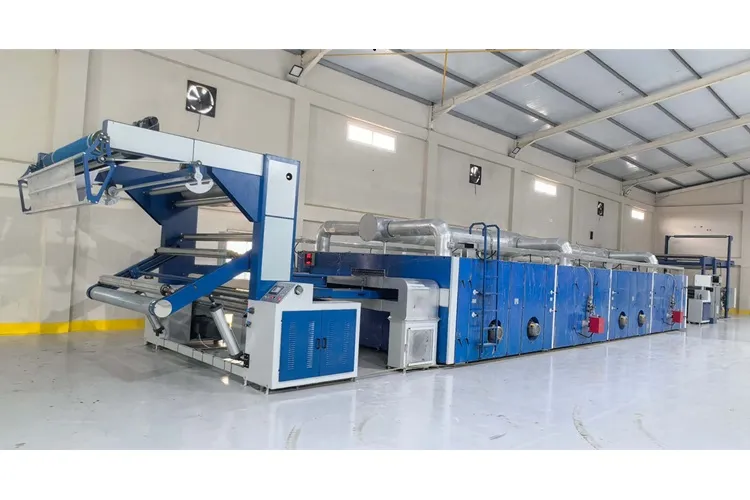

Sectional warping is a warping process in which the warp yarn is wound in sections according to the process requirements and finally combined into a complete weaving beam. Its core feature is to divide the total number of warps required for the fabric into several sections, each section of yarn is wound in parallel on a narrow segmented warp beam (usually the same width as the weaving beam), and then multiple segmented warp beams are assembled in parallel to form the final weaving beam.
Workflow
Sectional Winding: The warp yarn is drawn out from the creel, and is wound on a single segmented warp beam with uniform tension through the tension device, reed, and other components to form a narrow yarn layer.
Combined Weaving Beam: Multiple segmented warp beams are installed on the core shaft in sequence, and combined into a complete weaving beam through the beam combining process, which is directly used for weaving.
Technical Features of Sectional Warping
High-efficiency
Single-axis winding speed is fast, production efficiency is high, and it is suitable for extra-wide fabrics (such as industrial textiles).
Compact Structure
The segmented warp beam is small and easy to transport and store.
Tension Control
Ensure uniform tension during warping and reduce end breaks through tension rollers, yarn storage devices, etc.
Application scenarios
Warp Knitted Fabrics
Symmetrical pattern products such as curtains and mesh.
Industrial textiles
Wide fabrics such as geotextiles and composite base fabrics.
Yarn-dyed production
Suitable for symmetrical pattern designs that require a multi-color arrangement.
https://www.newpowertex.com/