


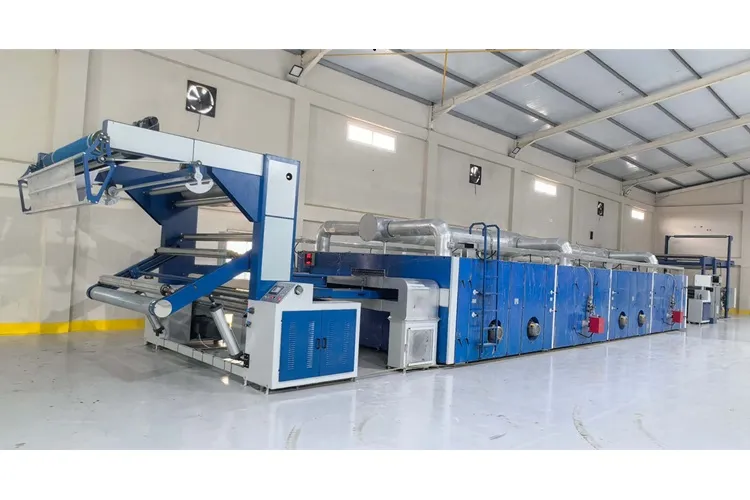

Common faults of the double needle bar warp knitting machine are mainly concentrated in mechanical operation, fabric quality, electrical control, and yarn processing. The following are typical problems and manifestations:
Mechanical operation failure
Needle bed jamming/abnormal noise
Cause: Insufficient lubrication of guide rails, wear of components (such as sliders, gears), installation accuracy deviation, or foreign matter jamming.
Performance: Abnormal noise during operation and poor movement of the needle bed may cause broken needles or holes in fabric.
Transmission component failure
Cause: Belt slack/wear, loose coupling, poor gear meshing.
Performance: Unstable speed, transmission slippage, and in severe cases, it leads to shutdown or fabric horizontal stripe defects.
Fabric quality defects
Broken yarn/holes
Cause: Excessive tension (such as excessive pre-stretching of elastic yarn), burrs on yarn guide components, wear of needle hooks or skewed installation.
Performance: Local yarn breakage in the fabric, forming holes or thin spots.
Uneven coils/curling
Causes: inconsistent comb tension (such as too low front comb tension), improper needle bed spacing, unstable warp feeding.
Performance: The coils on the fabric are of different sizes, and the edges are curled inward or outward, affecting the flatness of the fabric.
Horizontal stripes/defects
Causes: Mixed yarn batches, tension fluctuations (such as electronic warp feeding failure), and mechanical vibration causing the comb to shift.
Performance: Horizontal stripes with uneven color or density appear on the fabric.

Electrical and control system failure
Warp feeding/winding failure.
Causes: servo motor failure, encoder signal abnormality, control program parameter disorder.
Performance: The warp feeding is fast and slow, and the speed of the cloth winding roller is unstable, resulting in fabric density fluctuations.
Sensor false alarm
Causes: dust accumulation, position offset, or component aging of the photoelectric sensor.
Performance: Frequent false alarms (such as yarn break detection failure), affecting normal production.
Yarn processing problems
Uneven tension
Reason: Tensioner damping failure (such as washer missing), poor yarn guide path (such as improper yarn guide rod angle).
Performance: The tension of the same comb yarn is very different, resulting in inconsistent density on the left and right sides of the fabric.
Spandex loss of elasticity/breakage
Reason: The pre-draft multiple is too high, and the tension on the machine exceeds the elastic limit (such as >10cN).
Performance: The elastic fabric loses its restoring force, or the spandex yarn breaks frequently.
If you are interested in learning more about the double needle bar warp knitting machine, please visit www.newpowertex.com!
https://www.newpowertex.com/