


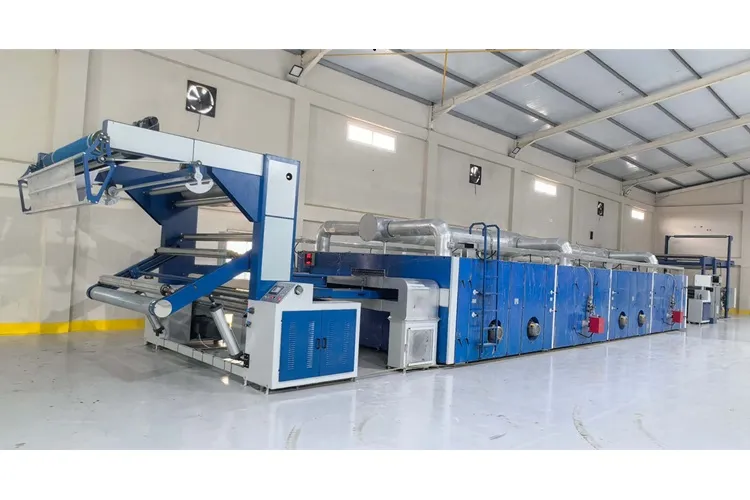

Precise debugging of equipment
Needle bed and comb positioning: Ensure that the deviation between the needle hook tip and the center of the yarn guide needle hole is ≤0.05mm. When padding yarn, the yarn must fall accurately into the needle hook, and the padding yarn trajectory can be calibrated by slowing down the machine.
The spacing between the needle bed and the sinker is adjusted according to the thickness of the yarn: fine yarn (0.05~0.2mm), coarse yarn (0.2~0.5mm). Too large a spacing can easily cause the yarn to slip out of the needle hook.
Moving parts synchronization: Check the timing of the comb bar lateral movement and the needle bed lifting and lowering. When the yarn guide needle swings across the needle plane, the needle bed should be in a low-position static state to avoid motion interference and yarn leakage.
Calibrate the sinker stroke: The amount of sinker backward movement needs to ensure that the old coil is stably held, generally 1.5~2.5mm (adjusted according to the thickness of the fabric). If it is insufficient, it is easy to lose the loop and miss the needle.
Raw materials and tension control
Yarn quality screening: Avoid excessive hairiness, uneven thickness, or strong twist yarns. Such yarns are easy to entangle with knitting needles or poor padding. It is recommended to use high-quality yarns with a hairiness index of <5.0 and a linear density variation coefficient of <1.5%.
Tension uniformity: The difference in tension of each combing bar yarn is controlled within ±5cN. Too low tension can easily cause yarn leakage, and too high tension will break the yarn. The tension sensor can be used for real-time monitoring to adjust the tensioner damping (recommended value: 8~15cN for fine yarn, 20~40cN for coarse yarn).

Process parameter optimization
Padding angle and yarn pressing depth: The yarn padding angle is controlled at 30°~45° (pad yarn before needle). Too large an angle makes it easy to slip the needle, and too small an angle makes it difficult for the yarn to enter the hook; the yarn pressing depth is preferably when the yarn guide needle presses to 1/3~1/2 of the needle bar to ensure that the yarn is stably embedded in the needle hook.
Speed and cleaning maintenance: When running at high speed (>2000r/min), clean the needle bed and yarn guide needle once an hour to remove fiber dust and avoid dirt accumulation that hinders yarn movement.
Regularly check the wear of knitting needles: When the radius of the hook tip is >0.03mm or burrs appear, it needs to be replaced, otherwise it is easy to hook the yarn and cause missed needles.
Quick abnormal handling
When missed needles are found, stop the machine immediately for inspection:
① Check whether the yarn guide needle at the corresponding position is bent (deviation >0.1mm needs to be replaced);
② Check whether the tension of the yarn on this route changes suddenly (such as yarn jamming in the tensioner);
③ Confirm whether the spacing between the needle bed and the sinker at the missed needle position is out of tolerance (measure point by point with a feeler gauge).
If you are interested in learning more about the Tricot warp knitting machine, please contact New Power for more consultation. Our professional team is on call at any time, willing to listen to your needs and provide you with tailored consultation and guidance.
https://www.newpowertex.com/